Director, actor and playwright Steven Berkoff knows a thing or two about the East End. He was born there 75 long years ago, a mere barrow boy’s shout from the chic Thames-side studio that is now his artistic base.
Yes the East End has changed and so too has Berkoff who fought his way from unpromising beginnings as the son of a Russian Jewish tailor to produce a radical body of theatrical work that has brought him both widespread acclaim and a certain degree of notoriety.
These days he’s recognised as a creative giant of the theatre, equally at home producing hard-hitting avant garde drama, adapting Shakespeare, Kafka and Sophocles or writing his own critically acclaimed original plays. He also has a parallel career as a Hollywood movie actor of course having appeared in a curious mixture of movies that include A Clockwork Orange, Octopussy, Rambo, Beverly Hills Cop and The Girl With the Dragon Tattoo.
It’s all a long, long way from the now lost world that Berkoff grew up in. Happily when he was just 11-years-old and kicking around the streets of Stepney someone gave him a camera. It sparked a lifelong interest in photography and a few years later when he acquired an enlarger and learnt how to print his own pictures, he was ready to go.
Armed with a second-hand Rolleiflex, Berkoff started photographing the people and places of the old East End – the markets, the street sellers, the potpourri of cultures brought to the area by immigrants.
By the 60s and 70s it became all too apparent that the bagel-sellers, chicken-slaughterers and other colourful characters that were the life and soul of East End London were slowly but surely disappearing. Berkoff’s photographs captured the last gasp of an era. “I felt I had to record it before it vanished forever,” he says.
Happily the pictures – now so historically important – have survived and have just been publishing in the book East End Photographs. There is also an exhibition of his prints which is currently showing at Lucy Bell Fine Art in East Sussex.
You can see ‘Steven Berkoff – East End Photographs’ at Lucy Bell Fine Art, St Leonards-on-Sea, until 21 Feb 2013. For book sales: www.lucy-bell.com
Who says that the cult of celebrity is a thing of the past? As Hobbit fever sweeps the cinema-going world someone with far more money than sense has bid £50,000 for JRR Tolkien’s old fireplace.
It is among items salvaged by the boss of the demolition company that pulled down the Lord of the Rings author’s old bungalow in Poole four years ago.
The joke is that Tolkien only lived in the house for three years from his retirement in 1968 until the death of his wife Edith in 1971.
What’s more he didn’t even like the place. A career academic, he would have much rather have stayed in his beloved Oxford.
However the success of The Hobbit and The Lord of the Rings meant he was constantly bothered by fans beating a path to his door.
The couple finally moved to the south coast to escape unwanted callers. They chose the seaside location partly because of Edith’s failing health butalso because for many years they had spent summer holidays at The Mirimar Hotel in nearby Bournemouth.
By all accounts Tolkien didn’t like it much there either, complaining that it was difficult to find someone to have a stimulating conversation with.
Playing Jesus Christ for Franco Zeffirelli 35 years ago has clearly paid dividends for actor Robert Powell. He’s been placed in the central position in photographer Alistair Morrison’s Actors Last Supper which is on display at the National Portrait Gallery.
Powell has been a stalwart of stage and screen for the past 40 years and has forged a reputation for the sheer breadth of his talents. Equally adept at high-brow and populist material, he has made critically acclaimed appearances for not just Zeffirelli but also directors like Ken Russell who cast him in the title role in Mahler.
Robert Powell: Photo Hattie Miles
However Powell is just as happy playing knockabout sit-com with his mate Jasper Carrott or appearing in popular TV dramas like Holby City. He recently joined the cast of the latest West End production of the hit musical Singin’ in the Rain too. No wonder Morrison chose him as one of the 13 leading British actors and directors he used to recreate, photographically, Leonardo da Vinci’s iconic 15th Century painting The Last Supper.
Morrison, who over the past 30 years has photographed everyone from Bette Davis to Laurence Olivier, used a cast that in addition to Powell included Steven Berkoff, Anthony Andrews, Simon Callow, Tom Conti, Peter Eyre, Sir Richard Eyre, Colin Firth, Sir Michael Gambon, Tim Piggott-Smith, Sir Antony Sher, John Alderton and Julie Walters
The portrait, which is over three metres long, was originally among images created to raise funds for a childrens charity through Variety’s Hidden Gems project. It has now been acquired for The National Portrait Gallery’s permanent collection.
Now here’s an intriguing theory. Esteemed editor Ruth Winstone, who I vaguely know through her work on nine volumes of Tony Benn’s diaries, suggests that the end of an era is nigh, that the age of the political diary may be over. Winstone should know. She has also edited three volumes by the former Labour MP Chris Mullins. Her argument is that the instant communication of blogs and social networking has effectively replaced what used to be a reflective private activity.
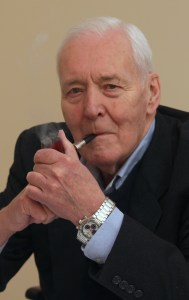
Tony Benn: Photo Hattie Miles
I’m pleased to see that Peter Wilby, writing in The Guardian, disagrees, pointing out that political diaries tend to give a sense of history behind the kind of scheming, plot or knee-jerk reactions that these days are so often the motivation/subject of politicians tweets. He has a point, but why single out political diaries? He implies that the same is not true of (mere?) memoirs. Surely it depends on the quality of both the writing and thinking as much as the actual subject matter. For example no one expects Cheryl Tweedy’s autobiography to contain an analysis of the changing soci0-demographic structure of the North East in the wake of the decline of the mining and shipbuilding industries but I’m guessing that the fact that she is a product of that era means that, amid the tittle-tattle and fluff, there’s something of that in there. Weightier memoirs (diaries/biographies) can contain a great deal of background and context.
As for blogs and tweets? They are by their very nature of the moment, a platform for comment, reaction, whimsical thoughts and maybe a little brow-beating. All could have their place in a diary but once filtered through a process of reflection, and with hindsight, can be very different indeed. My feeling is that traditional diaries, memoirs and biographies live on while social media provides another means of communication. All are valid and all will survive in some easily recognisable form.
Ironically Tony Benn is about to publish what he says is the final volume of his diaries. A Blaze of Autumn Sunshine even contains the subtitle The Last Diaries. Well he is 87-years-old but I wonder. The old political warhorse battles on. I suspect that that blaze of Autumn sunshine mentioned in the title might turn out to be an ongoing Indian summer.
Benn recently said that he gets immensely annoyed that people think he’s mellowed with age. He hates being regarded as a harmless old gentleman saying: “I may be old and I may be a gentleman but I’m certainly not harmless.”
Benn first made big headlines back in the early 1960s when as Lord Stansgate he renounced his peerage so that he could sit in the House of Commons. He went on to become the Labour Party’s longest serving MP and was a minister in both the Wilson and Callaghan cabinets. He resigned from Parliament more than a decade ago famously announcing that he was leaving Westminster to spend more time on politics. Nearly 12 years on he hits the road again on January 11th when he takes the first of a series of An Evening with Tony Benn shows to the Braintree Theatre in Essex. He still seems to have plenty to say and no doubt plenty to write about.
We went to an incredibly smart dinner the other night (at someone else’s expense I’m delighted to say). It was a black-tie do. Country mansion, Michelin stars, five course banquet that kind of thing. I dug out my seldom worn dinner-jacket for the occasion. It looked incredibly suave. To complete the illusion I needed to add my most stylish black shoes. Sadly they had worn out long ago but, as luck would have it, were still to be found in residence at the bottom of my wardrobe. Polished to within an inch of their lives they looked the business even though the soles were completely worn through. Our table of six included a well known Tv presenter, one of the wealthiest women in the land , two concert pianists and us. We had a great time. I enjoyed talking to the multi-billionaire sitting on my left happy in the knowledge that she need never know that I was literally on my uppers.
Author and naturalist Gerald Durrell found fame in the 1950s and 60s as the outspoken, larger-than-life best-selling writer who went on to establish the pioneering Jersey Zoo. Known these days as the Durrell Wildlife Conservation Trust, it is revered by conservationists across the world. It is also one of the biggest tourist attractions in the Channel Island’s.
However had a few local government big-wigs taken a more enlightened view 50 odd years ago, the zoo may well have found a home right here in Dorset. For Durrell, author of nearly 40 books including worldwide best sellers like My Family and Other Animals, originally wanted to establish his groundbreaking captive breeding programme at Upton House near Poole.
Sadly the local authority felt it was an unsuitable use for the grand Georgian property and the project was strangled by red tape. An environmental campaigner years ahead of his time, Durrell had been determined to start work on a project that would save threatened species from extinction.
By the late 1950s he had amassed a bewildering collection of animals in the back garden of his sister Margo’s home in the Bournemouth suburb of Charminster. He was already a well-known author and well on the way to establishing the project he named The Stationary Ark. He would have loved it to have been at Upton which has beautiful parkland and even its own island in Poole Harbour, but stymied by council bureaucracy, he lost patience and took his life’s work to the Channel Islands instead. Margo’s son, Gerry Breeze, describes the loss of the zoo to the local area as “a tragedy.”
Now 68 and still living just a half-a-mile from his childhood home, young Gerry used to feed and clean the animals in the back garden while his uncle was off on his globe-trotting expeditions He would later help build the cages for the Jersey Zoo and lived and worked there for a while, looking after the reptile house. Gerry – a seventh dan karate expert – invited me into his happily chaotic home, where Japanese and African masks adorn the garden walls, kiwi fruit grow in abundance and he still studies is beloved reptiles. It is a typically Durrell-like environment. Although as Gerry himself unwittingly pointed out this isn’t always obvious when viewed from the inside.
“When you’re growing up you just accept your family and the people around you as being normal,” he told me. “It was only years later that I realised what an extraordinary and interesting family I had.” Interesting indeed. Apart from Uncle Gerald there was also Uncle Larry (the writer Lawrence Durrell) and the gun-mad Uncle Leslie who used to keep a small armoury of weapons “including elephant guns, revolvers..everything” in the flat over the Bournemouth off-licence he ran with his wife Doris,
Then of course there was young Gerry’s mother, Margo – another charismatic character who would go on to write her own highly praised autobiography. The Durrell siblings are of course familiar from Gerald’s best-seller My Family and Other Animals. Although set on the Greek island of Corfu, the book actually opens on the precise cold, miserable, rainy day in Bournemouth that originally inspired the family to head for the sun.
His years in Corfu consolidated an interest in animals that had been growing since he was a toddler and collected wood-lice, earwigs… anything that crawled. He had already decided that school was an irksome business and had been removed from formal education after a single unhappy year. With private lessons and a freedom that few are privileged to enjoy, Gerald Durrell would go on to become a world-renowned expert in his field.
The man David Attenborough described as “magic” and whose Jersey project has saved entire species from extinction was not the easiest of people. He drank heavily, had a fearsome temper and didn’t suffer fools gladly.“He certainly had his moments.” Gerry Breeze told me. “He drank far too much and could swear like no one else I’ve ever heard. He was a remarkable man though. He used to go off on expeditions and bring all sorts back – we had monkeys, mongooses, snakes, birds, just about everything in that garden. I remember one day all the monkeys escaped. We found them as far away as Boscombe Gardens.”
“What on earth did the neighbours say?” I ask. “Not a lot.” replied Gerry. “The ones on the left used to grumble a bit but I don’t think they actually did anything.” The Durrell’s urban menagerie including a chimpanzee called Chumley who used to enjoy an occasional cigarette and drink. Thumbing through a dog-eared family album, Gerry finds a fading black and white picture. “Look there he is swinging on the curtains,” he chuckled. I can’t help noticing that Chumley is wearing clothes. “Gran used to make those,” explained Gerry. Looking at this handful of images that have now become history, he says he wishes he had taken more photographs. “I just didn’t realise how important it was at the time.”
Since Gerald Durrell’s death in 1995 at the age of 70, The Wildlife Conservation Trust has been run by his widow, Dr Lee Durrell. The couple met in the mid 1970s when the then recently divorced 53-year-old Gerald was on a lecture tour of America and Lee was a 27-year-old graduate student completing a PhD in animal communication. “I remember the moment he came into the room. It instantly seemed to light up. He was very high wattage person,” she tells me. Durrell was clearly taken by the young Memphis belle and the pair fell into deep conversation about Madagascan Lemurs. Two years later they were married.”
Lee believes that the loss and degradation of habitat is the biggest threat facing many of the world’s endangered species. Gerald, she says, may have been hard-drinking, volatile and in many ways a rather old fashioned character, but he was also a man of vision. He understood the threats facing the natural world long before most people had even given it a second thought. She gives an example “Gerry loved Corfu but when he went back in the 1950s and tourism was beginning to take off, he was appalled. He felt the Island was being ruined. He ranted and raved about it.Yet when he took me there in the 80s and tourism had more or less done its wicked thing. I thought it was magical. It’s a matter of perception.”
She now works tirelessly to promote the work of the Durrell Wildlife Conservation Trust. Encouraged by Gerry Breeze, she recently returned to Bournemouth, where she so often spent happy times with the extended Durrell family, to give a lecture at Talbot Heath School. It was the first of a series of illustrated talks which she hopes to give at locations around the UK and she was impressed by what she found.
“I spoke to the sixth form and it was so encouraging that the subjects they are studying in their science and geography classes are exactly the kind of things that we are working on. They knew all about biodiversity. They knew about the various world treaties and conventions that have been set up to regulate trade and protect different species, habitats and eco-systems. Twenty years ago you’d go into a school and the curriculum would be completely conventional. Now kids like these are really beginning to look at how the world actually works.”
*You can visit The Durrell Wildlife Conservation Trust at Les Augrès Manor, La Profonde Rue, Trinity, Jersey, Channel Islands JE3 5BP. For more information about how you can help their work protecting endangered species by becoming a Trust member go to www.durrell.org or telephone +44 (0) 1534 860000
Back in the sixties Andy Fairweather Low was a bone fide chart-busting pop star. He played Top of the Pops with Amen Corner and his face was on the bedroom walls of thousands of teenage girls.
By the seventies, this likeable Welsh singer and guitarist enjoyed a critically acclaimed but all too brief solo career. Blasted out of business by punk rock, he became a hired hand for some of the best in the business.
Andy Fairweather Low. Picture: Judy Totton Publicity
Which is why for the past quarter-of-a century the self-confessed “quiet man of rock” has been making other people’s music.
Now, after decades of travelling the world as a member of Eric Clapton, Roger Waters and Bill Wyman’s touring bands, he is back on the road in his own right.
Leading a superbly tight four-piece outfit, he has happily kissed goodbye to limousines, five-star hotels and concerts in stadiums and arenas.
As he approaches his sixtieth birthday he is getting back to basics, driving himself to gigs at small theatres and clubs across the country.
He gave it a whirl last year and was so excited by the reaction that he says: “After 40 years I’m doing exactly what I always wanted to do, playing my music to people who want to hear it.”
This weekend finds Andy playing two shows in deepest Dorset – the Tivoli Theatre, Wimborne, on Friday and the Barrelhouse Blues Club in Sturminster Newton on Saturday.
“It’s great,” he told me. “After so many years of playing in all these big, big bands with three guitar players, two keyboard players, horn sections, girl singers, entire orchestras. I’m really enjoying playing with a small unit.”
With Andy on guitar and vocals, his Eric Clapton band colleague Dave Bronze on bass, Dorset born session man Paul Beavis on drums and Richard Dunn, a man who has played with everyone from Van Morrison to Johnny Cash, on Hammond organ, it is quite a line-up.
“My role in all the jobs I’ve had with other people is to play specific parts,” says Andy. “Now I get to play and sing whatever I – and it’s very important that word I – whatever I want.”
He admits there has been a fairly drastic change in his on-the-road lifestyle but says he has no regrets about swapping a globe-trotting gig schedule for shows that are often within driving distance of home.
“When I was touring with Eric or Roger I got paid well, I ate well, I slept well and travelled well. Now, standing at the front of the stage each night, I don’t sleep too well and there are elements of worry about selling tickets, how the throat is going to be and whether we can find our way to the Travel Lodge, but you know at the same time it’s very, very rewarding.”
Where once there was a team of tour managers there’s now sheet of dates and the sat-nav on the dashboard. As for the hotels he says simply: “I’ve stayed in some very classy places in my time but I don’t care how good a hotel is, I don’t care how good the menu is, there’s only one place you want to be when you’ve been on the road for six months. The fact is I want to spend more time with my grandson.”
The current 35-date tour which includes a performance at Glastonbury, is accompanied by the release, on June 2, of The Very Best Of Andy Fairweather Low – The Low Rider, a CD that surveys his entire career.
It features 14 of his best-known tracks, mixing re-recorded versions of his biggest hits with some of the most popular live numbers that he plays on tour.
It has been an extraordinary career for the boy from Cardiff who first found fame with numbers like Bend Me Shape Me, Hello Susie, (If Paradise Is) Half As Nice and of course the amazing Gin House Blues.
His solo career spawned favourites like Wide Eyed and Legless, Spider Jiving and La Booga Rooga while his session work included not only long-running employment with Clapton, Waters and Wyman’s bands but stints with everyone from Bob Dylan and Jimi Hendrix to The Who, George Harrison and BB King.
Throughout it all he stuck to what he knew and now in a high-tech world awash with gadgets and gimmics he seems both surprised and grateful that his old-fashioned skills are still considered cutting edge.
“I play an amp and a valve and I have a lead that goes into a guitar and that’s it. I never bought into the tricks. God knows how I’ve survived in a world where equipment has changed so much but somehow I have.”
*Andy Fairweather Low and his and band play at The Tivoli Theatre, Wimborne, on Friday (May 30) and The Barrelhouse Blues Club at the Exchange, Sturminster Newton on Saturday (May 31).
My Bed by Tracey Emin a big attraction at the Saatchi Gallery’s latest YBA show
By Jeremy Miles
THE gang’s all there. Mad Tracey Emin from Margate with her trashed bed, dodgy Damien Hirst from Leeds with his dismembered animals … Then there’s Marcus Harvey’s portrait of Moors Murderer Myra Hindley constructed from the handprints of children and Marc Quinn’s sculptural self-portrait made out of several litres of his own frozen blood. It’s hard to imagine how much of a furore these not-so-young British artists have managed to cause with these and other radical works over recent years. Their art has been attacked, vandalised and the subject of acres of vitriolic newsprint.
In the case of Quinn’s blood-head it was even allegedly melted. Not by an act of vandalism but by a hapless workman who turned the refrigeration off while working on Nigella Lawson’s kitchen. Then there was that cleaner who binned a pile of old cigarette ends, half-empty wine glasses and other assorted “rubbish” only to learn that it was very expensive work of conceptual art by Damien Hirst. My how the tabloids lapped that one up. They hadn’t had such a good laugh since dear old Carl Andre flogged his pile of bricks to the Tate just over the river.
Now of course the YBAs are part of the London tourist trail and these works are among the star exhibits in Charles Saatchi’s remarkable new gallery housed in the old committee rooms, corridors, offices and library at County Hall. And how great they look set against the sober and rather stuffy backdrop of this fine Edwardian building with its parquet flooring and ambience of faded grandeur.
Putting aside the astonishing turn of fate that means that Saatchi – Margaret Thatcher’s ad man -– has now taken control of a big lump of the former GLC citadel of her arch enemy “Red ” Ken Livingston, what has been created is a great gallery. There’s something a bit unreal about it too. The original offices remain seemingly untouched, their original mantel-pieces, fireplaces and clocks, (all set at different times, I noted), looking just as though the pen-pushers have left for the weekend and the furniture has been moved out for someone to slap a new coat of emulsion on the wall. What if one of their ghosts returned, wandering along from Waterloo Station to discovered that their office, where budgets were once adjusted and memos written in triplicate, was now home to Chris Ofili’s portrait of the Virgin Mary complete with elephant dung, or a Damien Hirst pharmacy poster offering pie and chips in 100 milligramme capsules? It’s a wonderful thought and one that gives an intriguing insight into the curious nature of changing times, places and values.
The works on show at County Hall are not of course the fevered creations of unhinged lunatics that certain elements in the popular Press would have us believe. They are, like it or not, the product of some of the most creative minds in Britain today and a vital and important part of the on-going debate that says that art should question and challenge rather than just sit in a frame and look pretty.Certainly this gallery with its prime position on the banks of the River Thames right next to the London Eye is attracting tens of thousands of visitors.
It is also one of the three stop-off points for the new Tate to Tate Ferry. This service, a godsend for art lovers, is a flash 220-seat river bus decorated with Damien Hirst spots, which shuttles passengers between Tate Britain at Millbank and Tate Modern at Bankside calling in at County Hall on the way. The journey which lasts just 18 minutes takes in one of the best cityscapes in the world and is also a great way of travelling between the Westminster/Millbank area and The City. A £4.50 ticket allows you up to three return journeys.
At the moment the Tate Britain is of particular interest those au fait with the local art scene as it is host to the first full-scale international art museum show by Bournemouth trained photographer and 1999 Turner Prize winner Wolfgang Tillmans. German-born Tillmans, who studied at the Bournemouth and Poole College of Art and Design and returned there last year to receive an honorary degree is an extraordinary artist, obsessively exploring everything from the magnificent to the mundane.
This massive show, taking up seven rooms at the Tate Modern, is called If One Thing Matters, Everything Matters. It’s a point that is rammed home as room after room displays images that range from socks rolled up on a sofa to pieces of orange skin, a bunch of keys, clubbers, sexual encounters, Concorde, the Halle Bop comet and some intriguing experimentations with photographic dyes. Some are just prints stuck to the gallery wall with pieces of tape, others hang from bulldog clips. In a world where we are bombarded by millions of visual images, it’s intriguing to encounter someone who finally understands their mind-numbing normalcy. And to put a show like this in the Tate Britain is every bit as radical as the display offered by Saatchi’s not-so-bad boys and girls across the water.
* Wolfgang Tillmans’ If One Thing Matters, Everything Matters is at Tate Britain until September 14. Call 020 7887 8888. For information about The Saatchi Gallery at County Hall call 0207823 2363. For information on how to get there and where to stay visit (website)visitlondon.com